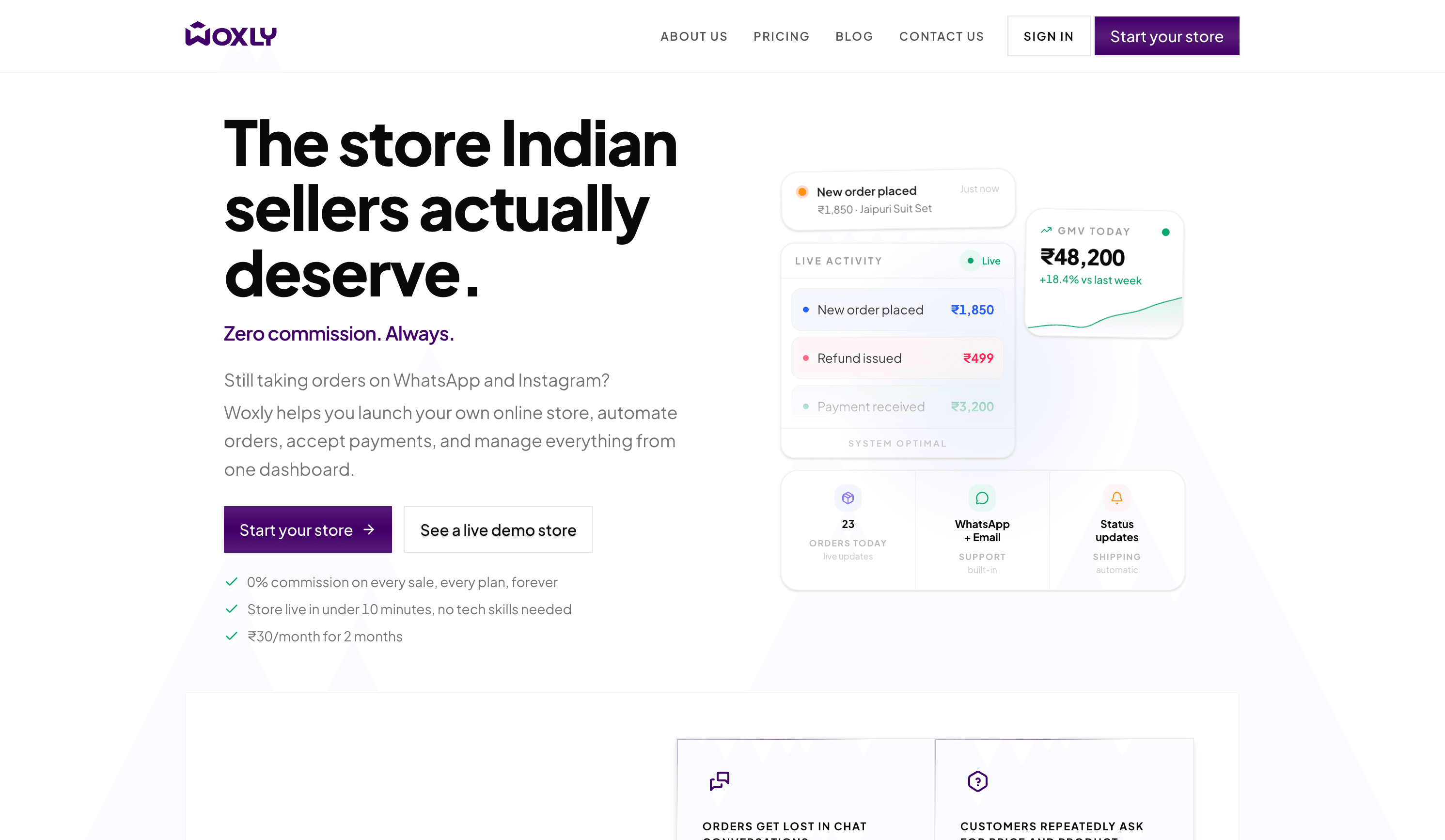
Overview
Woxly is a multi-tenant commerce platform for small sellers who outgrew WhatsApp, Instagram DMs, and spreadsheet inventory. It connects a marketing site, a vendor dashboard, and tenant storefronts on one commerce core — so store setup, checkout, and fulfillment share the same source of truth.
Problem
Sellers were running inventory and orders across DMs and sheets. Payments were unclear, fulfillment lagged, and there was no shared ops view. Existing tools either assumed enterprise scale or forced merchants to stitch together disconnected apps.
Goals
- Give sellers a path from “I need a store” to live checkout without a custom build
- Keep merchant data isolated while reusing one product, order, and payment model
- Make vendor ops scannable: sales, orders, status, and exports in one place
- Wire real payments (Razorpay) into a post-payment order lifecycle
Approach
Ship three surfaces on shared commerce primitives — products, customers, orders, and payment state — with tenant-aware routing so each merchant’s context stays isolated.
woxly.store carries positioning and a clear path into store creation. The landing page converts into onboarding.
app.woxly.store is the ops surface: KPIs, order lists, filters, status workflows, and exports. Role-separated flows keep vendor and customer concerns apart.
demo.woxly.store is the customer-facing shop — browse, cart structure, and checkout wired to Razorpay, then handoff into fulfillment state.
Screens
Screens
Architecture
- Tenant-aware routing for storefronts and merchant isolation
- Shared core for products, customers, orders, and payment state
- Role-separated vendor vs customer flows
- Modular frontends so landing, app, and storefront stay consistent without sharing every UI concern
Outcome
- Landing with a clear CTA into onboarding
- Dashboard for sales, orders, filters, and exports
- Storefront shopping path wired to payments
- Razorpay checkout and a post-payment order lifecycle sellers can actually run
Stack
Next.js, TypeScript, Tailwind CSS, Razorpay.